Bookshelf Decor Ideas: 36 Stylish Styling Designs
A bookshelf is never just storage — it is one of the largest pieces of “art” in a room,…

A bookshelf is never just storage — it is one of the largest pieces of “art” in a room, and how you style it decides whether the whole space feels collected and calm or cluttered and chaotic. The good news is that beautiful shelves follow learnable formulas: a balance of books and objects, breathing room, layers of texture, and a few personal pieces that tell your story. Whether you are working with a grand built-in library wall or a single narrow bookcase, the same principles scale up and down beautifully.
In this guide you will find 36 bookshelf decor ideas, from color-coded arrangements and horizontal stacks to trailing plants, woven baskets, layered art, lighting tricks, and seasonal refreshes. Each idea comes with practical styling guidance so you can shop your own home first, arrange with confidence, and end up with shelves that look professionally styled but still feel like you. Start with one shelf, step back often, and let the formulas do the heavy lifting.
1. Color-Coded Book Arrangements

Arranging books by spine color is the fastest way to make a large collection look intentional. Group reds with reds, blues with blues, and neutrals together, then run the groups across shelves in blocks or in a gentle rainbow gradient. The color blocking turns dozens of mismatched covers into a designed pattern, and it works especially well on big built-ins where a random mix would look visual noise. Keep dust jackets on for maximum color, or remove them for a softer, vintage feel.
If a full rainbow feels too bold, try a partial version: devote just one or two shelves to a single color family, like all-white and cream spines, and style the rest traditionally. You can also flip books so the page edges face out for a uniform sandy tone — a controversial trick, but undeniably calm. Whatever route you choose, leave small gaps between color blocks and drop in a plant or object so the blocks read as chapters rather than stripes.
2. Horizontal Stacks Mixed with Vertical Rows
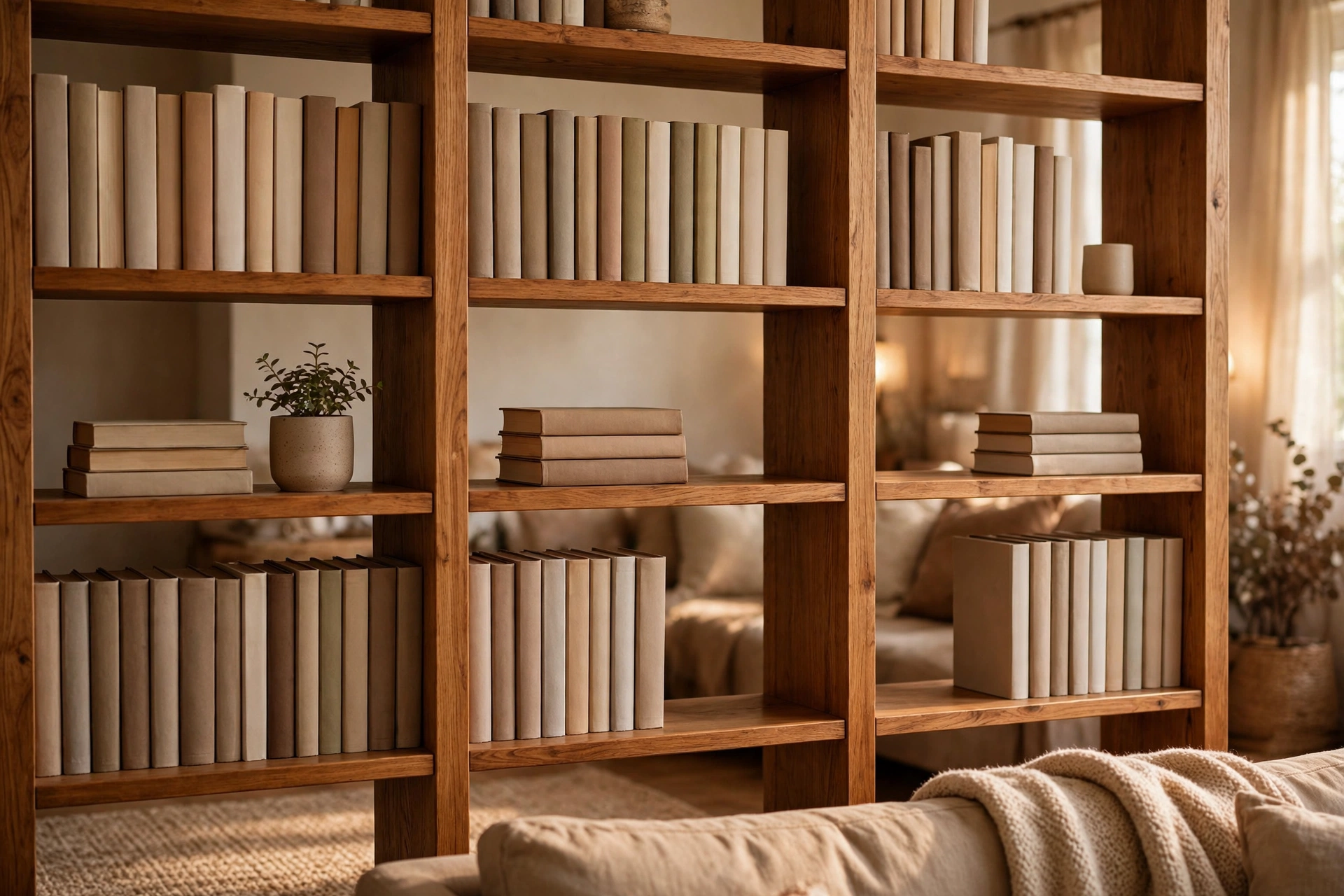
The single most useful styling move is alternating direction: stand most books vertically in rows, then break the rhythm with short horizontal stacks of two to four books. Stacks create natural pedestals for a small plant, a candle, or a sculptural object, and they give the eye a place to rest between tall rows. Aim for roughly two-thirds vertical and one-third horizontal across the whole bookcase for a balanced, designer look.
Keep stacks low and deliberate — three chunky art books read as furniture, while a teetering tower reads as storage. Use your largest, heaviest books at the bottom of a stack and graduate sizes upward. On shelves with very tall books, a horizontal stack also solves the awkward problem of one oversized volume; lay it flat, top it with a small bowl or framed photo, and it becomes a feature instead of a misfit.
3. Statement Bookends

Bookends do double duty: they keep partial rows standing straight and they act as sculpture. A pair of marble, brass, agate, or cast-iron bookends can anchor an entire shelf the way jewelry finishes an outfit. Use them to hold up a short row of books in the middle of an open shelf, creating a defined vignette with breathing room on both sides. Heavy materials matter — a bookend should genuinely support weight, not just decorate.
If you do not own formal bookends, improvise with heavy objects you already have: a chunky geode, a small potted plant in a ceramic pot, a vintage camera, or a stack of two horizontal books turned sideways. The trick is visual weight — the object needs enough mass that the eye accepts it as an anchor. One strong bookend moment per shelf is plenty; more starts to feel like a gift shop display.
4. Trailing Plants and Greenery

Every styled bookshelf needs something alive. Trailing plants like pothos, philodendron, and string of pearls soften the hard geometry of books and shelves, spilling over edges and connecting one shelf to the next. Place a trailing plant on a high shelf so the vines cascade down through the arrangement, and tuck small upright plants — a fern, a snake plant cutting, a tiny succulent — at the ends of rows where a bookend would go.
Choose pots as deliberately as the plants: terracotta for warmth, matte ceramic for a modern look, woven seagrass for texture. Repeat one pot style two or three times across the bookcase to create rhythm. If your shelves get little natural light, use high-quality faux greenery without guilt — a good faux trailing plant styled well beats a struggling real one. Leave room for growth, and rotate plants occasionally so all sides get light.
5. Woven Baskets for Tidy Storage
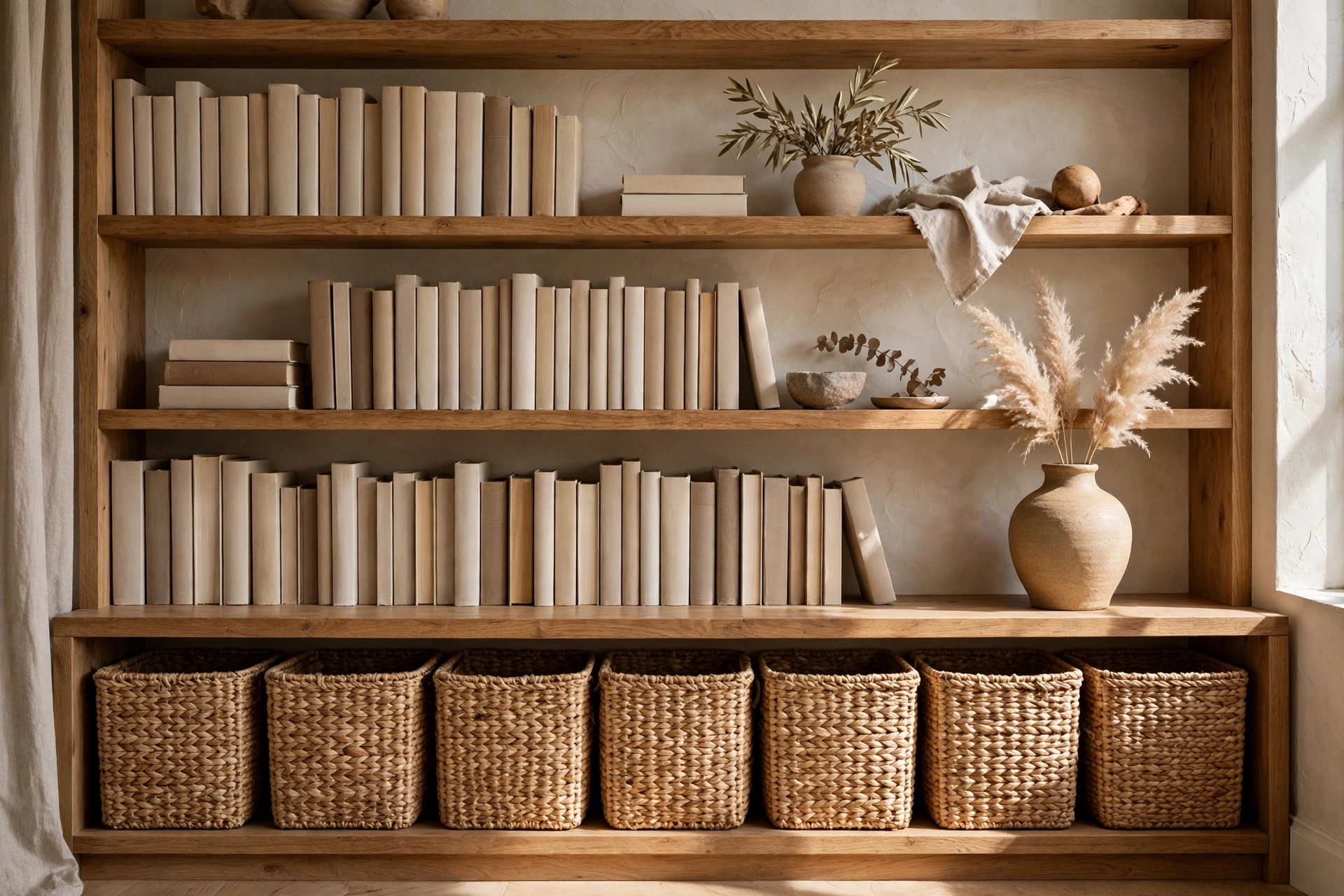
Baskets are the secret weapon of shelves that need to work hard. A row of matching woven baskets on the lowest shelf hides chargers, remotes, board games, kids’ clutter, and paperwork while adding warm, natural texture. Lower shelves suit baskets best because they are heaviest and least visible, which also grounds the whole bookcase visually — heavy at the bottom, lighter and airier toward the top.
Measure before you buy: baskets should slide in with an inch or two of clearance and sit flush or slightly recessed, never bulging past the shelf edge. Matching baskets look calm and built-in; a mix of natural fibers in similar tones looks collected. Add small unobtrusive labels if the baskets hold household supplies, and keep one basket purposely empty-ish for the inevitable drop-zone clutter that every living room generates.
6. Framed Art Layered Against Books
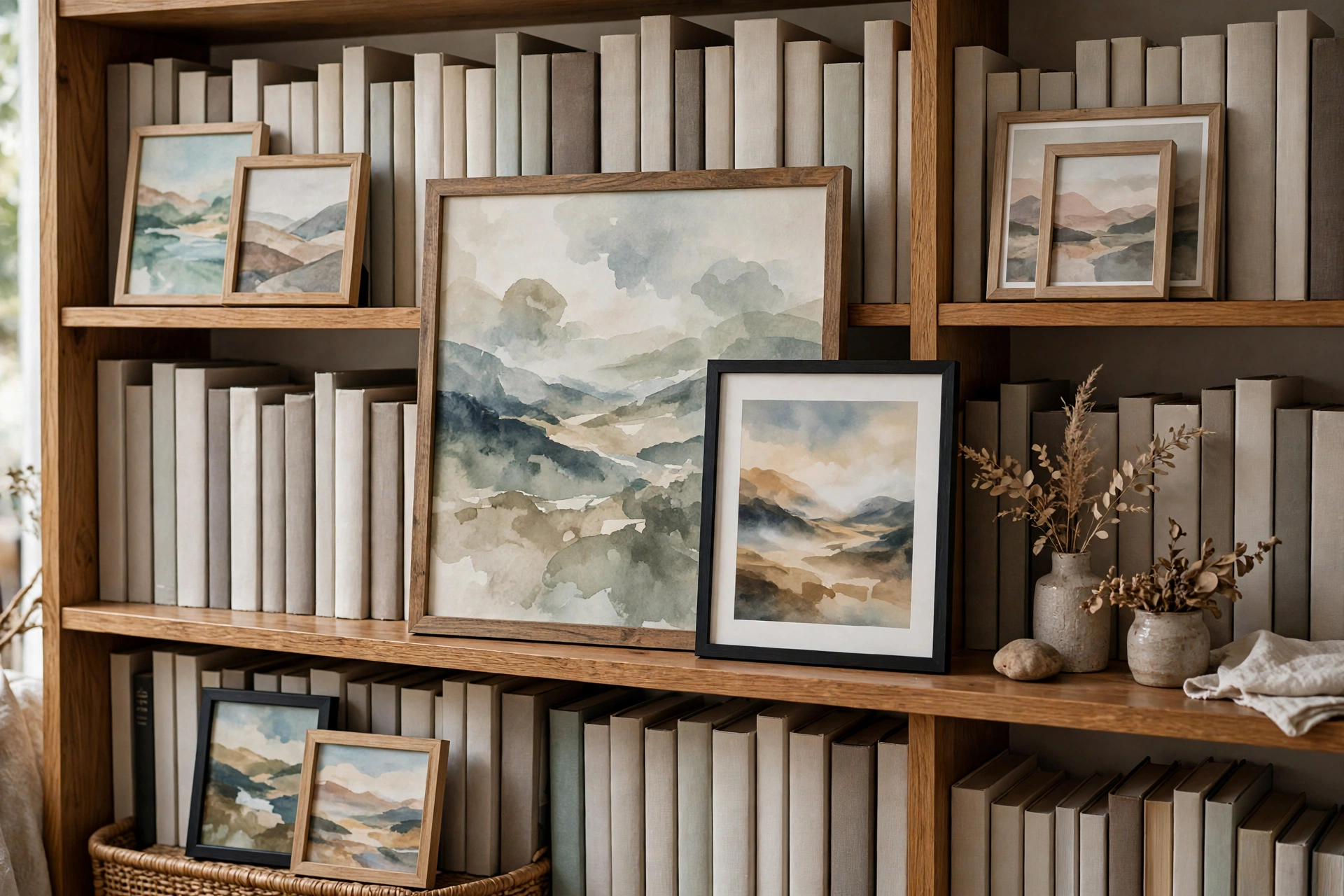
Leaning a small framed print or photograph against a row of books instantly makes shelves feel curated rather than stored. Layering is the key word: place a larger frame at the back, overlap a smaller one in front, and let books flank the pair. This depth — objects in front of books, frames overlapping spines — is what separates styled shelves from library stacks. Art also breaks up long runs of spines with imagery and color.
Use art you already own: postcards in frames, calendar pages, children’s drawings, or small thrifted landscapes. Keep frames in a loose family — all wood tones, or all black and gold — so the mix looks intentional. On deep shelves, lean art at the very back and stand a short stack of books in front of it; on shallow shelves, a single small frame propped on a stack works beautifully. Leave the glass in for photos, or remove it to kill glare in bright rooms.
7. Floor-to-Ceiling Built-In Shelves

Built-in bookshelves that run floor to ceiling and wall to wall are the dream backdrop of a living room or study, and they reward a systematic styling approach. Start by distributing your books evenly across the whole unit rather than filling one section completely, then add objects in a loose zigzag pattern so no two adjacent shelves carry the same arrangement. The topmost shelves, which are hardest to reach, are perfect for display-only pieces and rarely touched reference books.
Paint is the built-in’s best friend: painting the shelves and wall behind them one color — deep green, inky blue, warm white — makes the unit read as architecture and lets the books and objects glow against it. Add crown molding and a library ladder if the budget allows, or fake the look with tall freestanding bookcases anchored side by side and trimmed out. Keep everyday reads on the middle shelves at arm’s height where they belong.
8. The Rule of Thirds Styling Formula
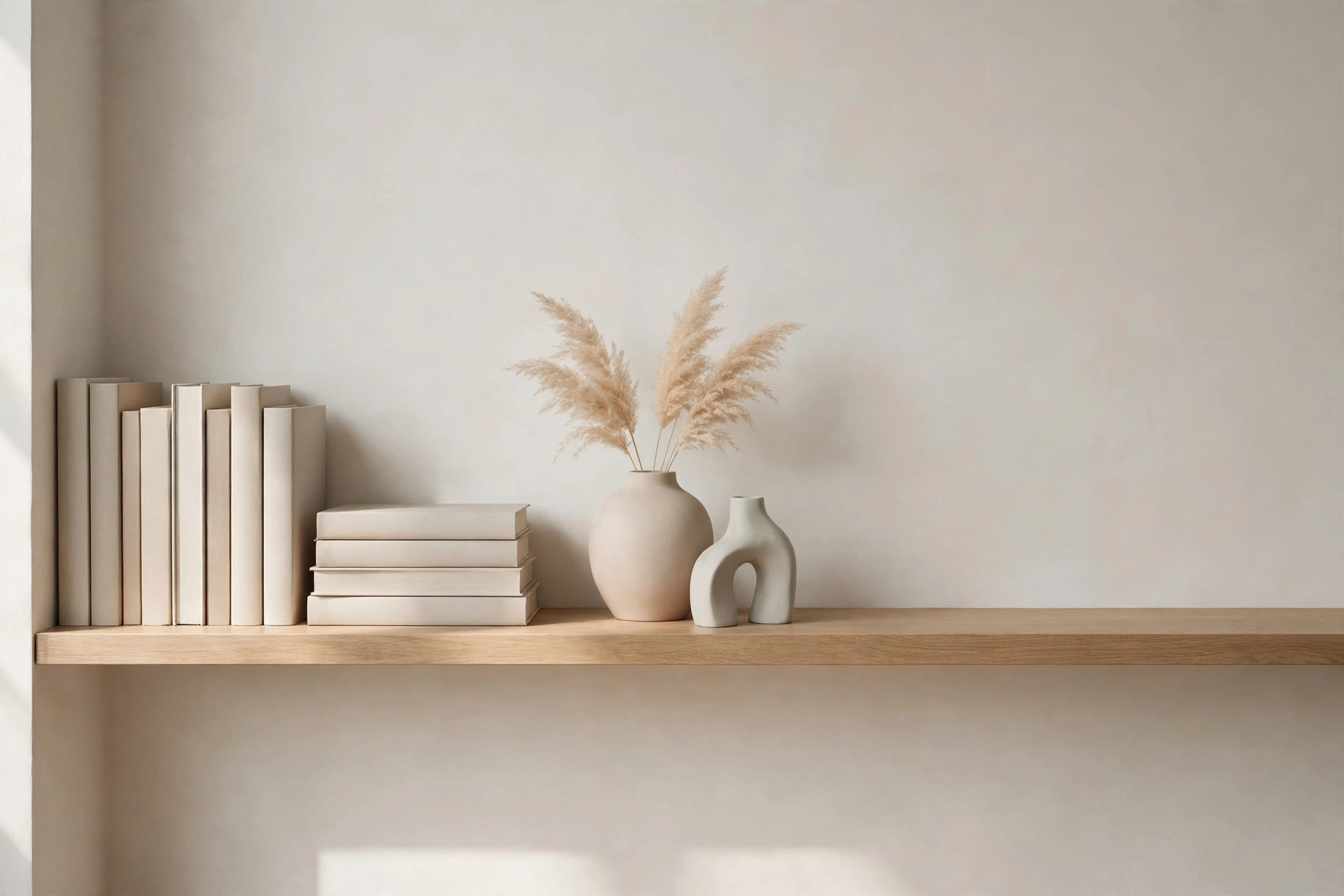
When a shelf feels “off” and you cannot say why, the rule of thirds usually fixes it: aim for roughly one-third books, one-third decorative objects, and one-third empty space on each shelf. The empty third is not wasted — it is what lets the other two-thirds register. Most amateur shelves fail by being ninety percent books; most showroom shelves succeed because they are ruthless about negative space.
To apply the formula, empty one shelf completely, then place books first in one or two groups, objects second, and stop before the shelf feels full. Step back three feet and squint: you should be able to describe the shelf in three chunks. Repeat shelf by shelf, varying which third goes where so the pattern does not repeat mechanically. This single formula, honestly applied, will improve any bookcase more than any purchase.
9. Ceramic Vases and Handmade Pottery

Pottery brings organic shape and matte texture that books and frames cannot. A single handmade vase with an uneven glaze, a cluster of small bud vases, or a chunky studio-pottery bowl gives shelves a collected, artisanal layer. Odd numbers work: group three vessels of different heights together, or stand one tall vase alone as a punctuation mark at the end of a row of books.
Empty vessels are fine — pottery is sculpture — but a few stems of dried grasses, eucalyptus, or pampas add height and softness without watering duties. Thrift stores and local makers are the best sources; look for pieces in your shelf’s color palette and do not worry about perfect condition. Repeat ceramic tones two or three times across the bookcase so the pieces converse with each other rather than appearing randomly.
10. Small Bookshelf Styling

A small bookcase — two or three shelves, a nightstand stack, a hallway etagere — needs the same formulas in miniature, with even more discipline about editing. On a small shelf, every object is magnified, so choose fewer, larger pieces over many small ones: one stack of three books, one plant, one framed photo can fill a shelf beautifully. Crowding is the enemy; if it looks busy from across the room, remove one thing.
Small shelves are also the perfect place to rotate displays: a seasonal vignette, a new-arrivals pile from the library, a collection of the moment. Use the top surface as part of the composition — a lamp, a plant, or a leaning piece of art on top of a low bookcase extends the styling vertically. In rentals and small apartments, a well-styled small bookcase often does more for a room than any other single piece of furniture.
11. Seasonal Styling Swaps
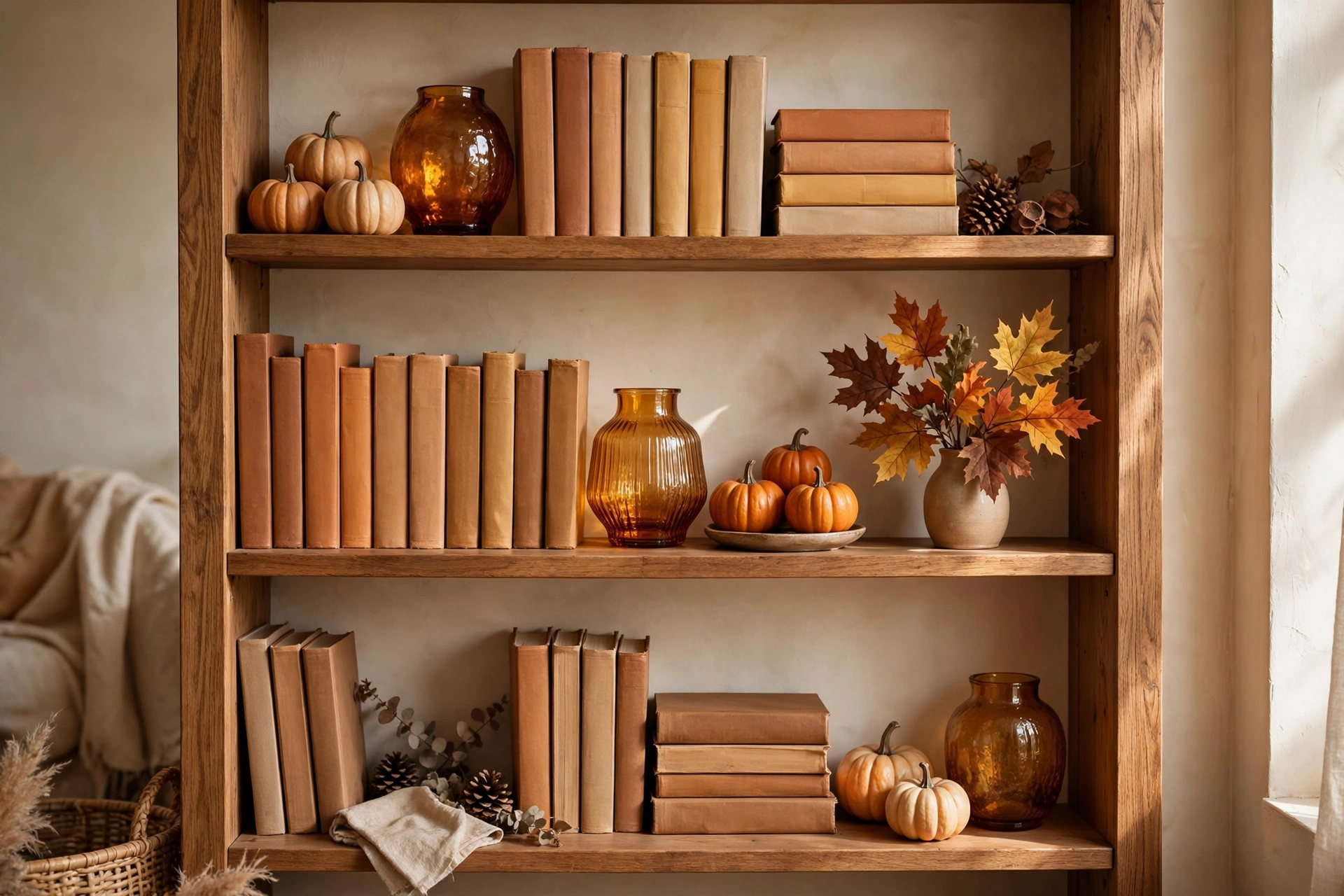
Shelves are the easiest place in the house to mark the seasons, because a few swaps change the whole mood without moving furniture. In autumn, lean in with warm wood tones, a small pumpkin or two, amber glass, and a plaid throw draped nearby. Winter invites evergreen sprigs, candles, brass, and a strand of fairy lights woven along one shelf. Spring means lighter pottery, fresh or faux blossoms, and pulling the pastel book spines to the front.
Keep a single storage box labeled “shelf decor” with your seasonal pieces so the swap takes twenty minutes, not an afternoon. The discipline is subtraction: for every seasonal object you add, remove one everyday object to the box, so shelves never creep toward clutter. Photograph your favorite arrangements before you dismantle them; next year you can recreate the look in minutes or improve on it deliberately.
12. Picture Lights and Shelf Lighting
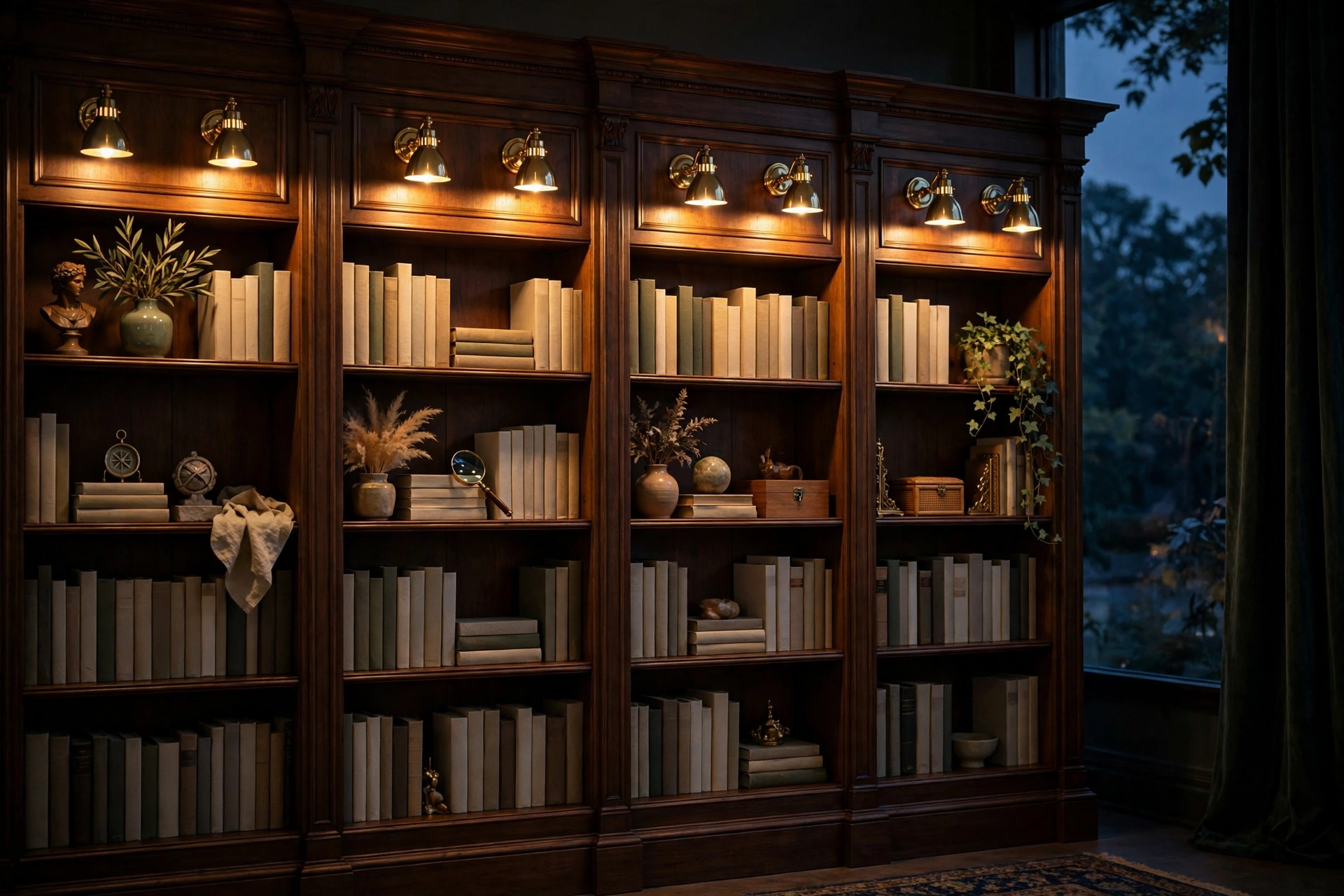
Lighting transforms shelves from flat storage into a glowing focal point, especially in the evening. Brass picture lights mounted above a bookcase or along the top of built-ins wash the shelves in warm light and give an instant library feel. Battery-powered puck lights and LED strip lights tucked under each shelf edge are the renter-friendly version — invisible by day, dramatic by night, and cheap enough to use along every shelf.
Choose warm-white light (2700K–3000K) so wood tones and book cloth look rich rather than clinical, and put lights on a dimmer or smart plug so the shelves can glow low in the evening. A small table lamp on one shelf, or a candle-style sconce flanking the bookcase, layers beautifully with overhead strips. Light also justifies display: objects you have lit read as art, which makes the whole arrangement feel intentional.
13. Glass Cloches and Collected Curiosities

A glass cloche turns any small object into an exhibit. Place one over a stack of vintage books, a coral fragment, a pocket watch, a nest, a tiny plant, or a collection of matchbooks, and suddenly the shelf has a moment of museum-like intrigue. Cloches also protect delicate or dusty items, and their height — usually taller than the books around them — adds the vertical punctuation every shelf arrangement needs.
One or two cloches per bookcase is the sweet spot. Vary what lives inside them seasonally: pinecones and a miniature tree in winter, shells and sand dollars in summer, a small pumpkin in autumn. If cloches are not your style, the same principle works with glass-front boxes, apothecary jars, and bell jars — anything transparent that frames an object and tells the eye “this one is special.”
14. Brass, Marble and Metallic Accents
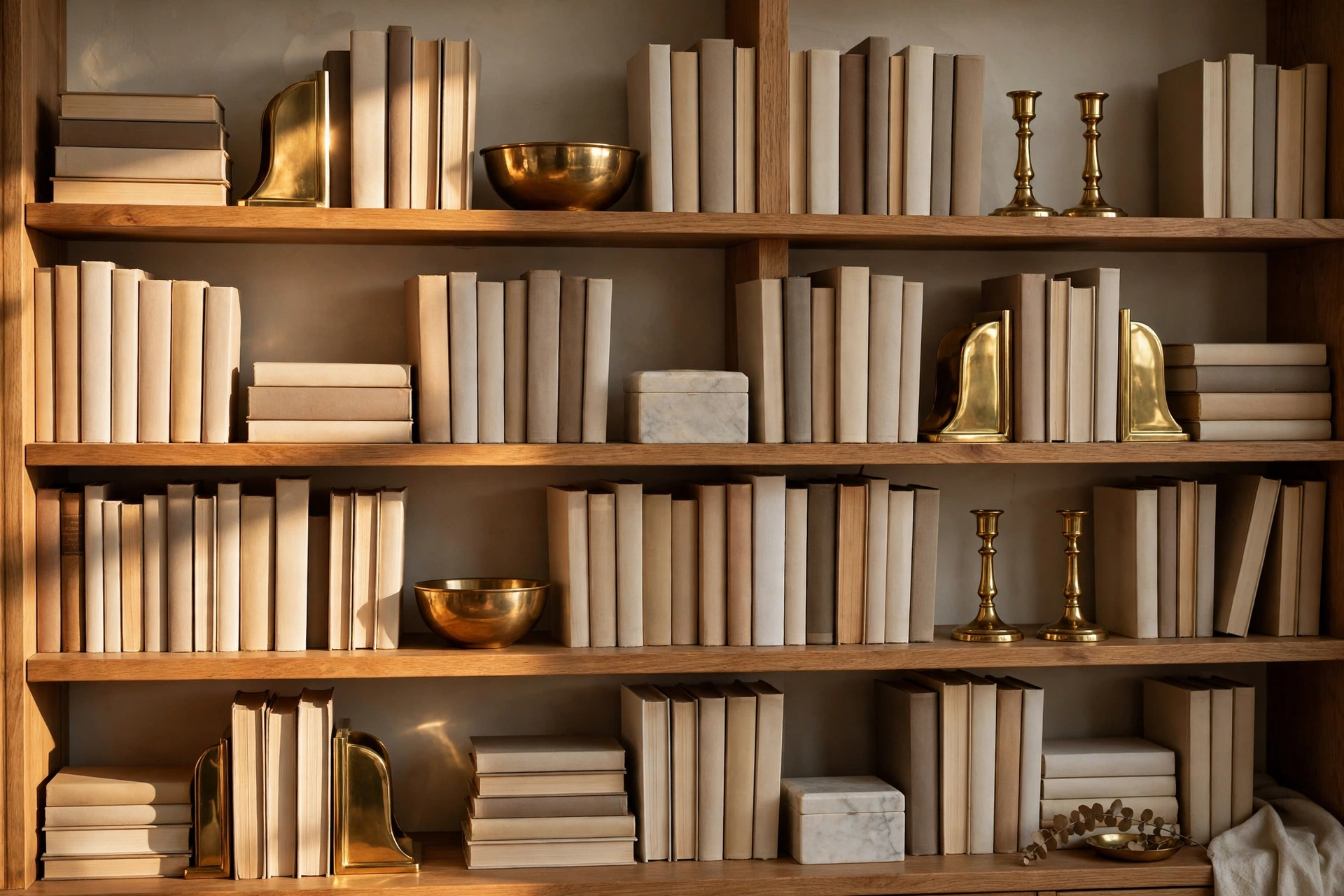
A thread of metallic accent woven through a bookcase makes the whole piece feel polished and expensive. Brass is the classic choice — bookends, a small bowl, picture frames, a clock, candlesticks — but marble trays and boxes, silver trays, and blackened iron all work. The key is repetition: the same metal appearing three or four times across different shelves creates a rhythm the eye reads as a deliberate design choice.
Metallics also catch light, which matters on shelves that can fall into shadow. Place one shiny object where lamplight or window light will hit it and the shelf gains a highlight. Mix no more than two metals, and let one dominate. If your shelves feel flat and matte — all cloth, wood, and paper — a single afternoon of adding brass or marble pieces will lift them more than any rearrangement.
15. Floating Shelf Styling
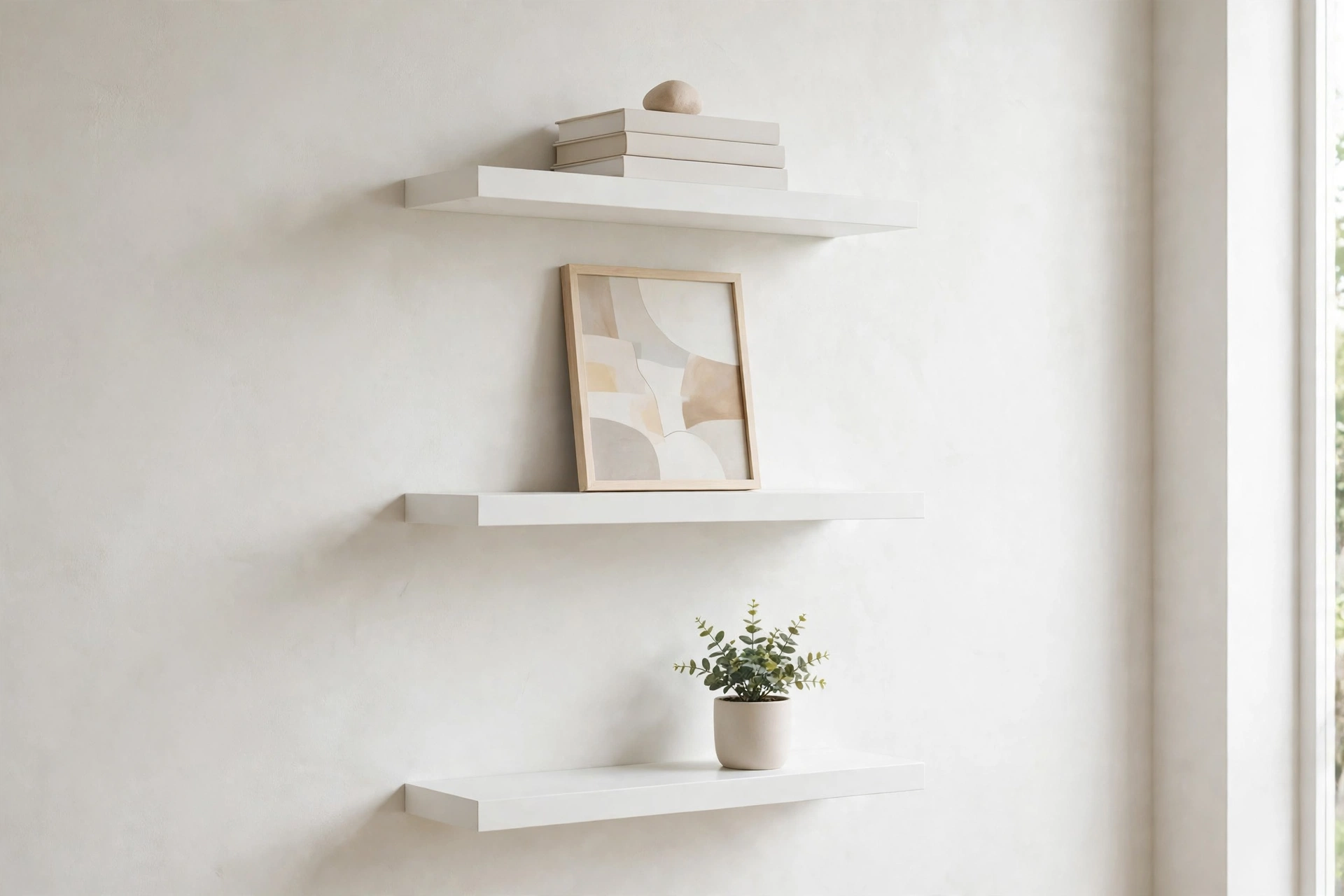
Floating shelves have no sides or back to contain an arrangement, so styling them is an exercise in restraint. Treat each floating shelf like a mantel: one anchored group, not a row of items spread edge to edge. A short stack of books with an object on top, a leaning frame, and a small plant — arranged as a single cluster slightly off-center — almost always beats a line of evenly spaced pieces.
Leave the ends of floating shelves empty; items pushed to the very edge look like they might fall and make viewers subconsciously uneasy. Coordinate the shelves as a column: if the top shelf’s cluster sits left, move the next cluster right, creating a gentle zigzag. Because floating shelves often live in kitchens, bathrooms, and entryways, favor objects that tolerate being moved for dusting — fewer, chunkier pieces win again.
16. A Cozy Reading Nook Shelf

The most charming bookshelf in any home is the one pressed into service beside a reading chair. Style a nook shelf for comfort and ritual: current reads in easy reach, a small lamp or candle, a coaster waiting for tea, and a soft throw over the chair arm. This is a working shelf, so perfection matters less than invitation — slightly lived-in is the aesthetic, as long as the piles look tended rather than toppling.
Personal pieces belong here more than anywhere: the framed photo, the souvenir stone, the mug that holds your bookmarks and reading glasses. Keep one shelf or surface deliberately clear for the book in progress and a drink; a nook that cannot accept a cup of tea has failed its purpose. If space allows, a small side table shelf unit — books below, lamp above — creates the complete reading station in under a square meter.
17. Vintage and Antique Book Displays

Old books are decor in their own right: cloth bindings in faded jewel tones, gilt lettering, marbled endpapers, and deckled pages bring a patina no new object can fake. Display them proudly in stacks tied with twine, in rows behind glass, or fanned open on a small stand to a favorite illustration. Estate sales, library sales, and thrift shops sell them by the box, often priced by the inch.
Handle fragile volumes gently and keep them out of direct sun, which fades spines fast. Mix vintage books with your modern reads rather than segregating them — the contrast of a worn leather spine beside a crisp new novel is exactly the collected look most styled shelves aim for. A few antique accessories nearby — a magnifying glass, brass reading light, or letter opener — completes the scholarly vignette without tipping into theme-park territory.
18. Scandinavian Minimalist Shelves

Scandinavian shelf styling is a masterclass in calm: pale wood shelves, a restrained palette of white, black, natural linen, and light oak, and generous empty space around every object. Books are often sorted by neutral tones — or turned to their page edges — and decor is limited to a few functional, beautiful pieces: a ceramic vase, a candle, a small plant, a woven basket. Nothing is on the shelf that is not either useful or genuinely loved.
To borrow the look without buying a thing, start by subtraction: remove half the objects from one shelf, group the remaining books tightly, and let the gaps breathe. Choose one accent color at most — soft black is the classic — and repeat it sparingly. Natural light is part of the formula, so keep Scandi shelves away from heavy drapes and dark corners where their quiet palette would turn dull instead of serene.
19. Maximalist Layered Shelves
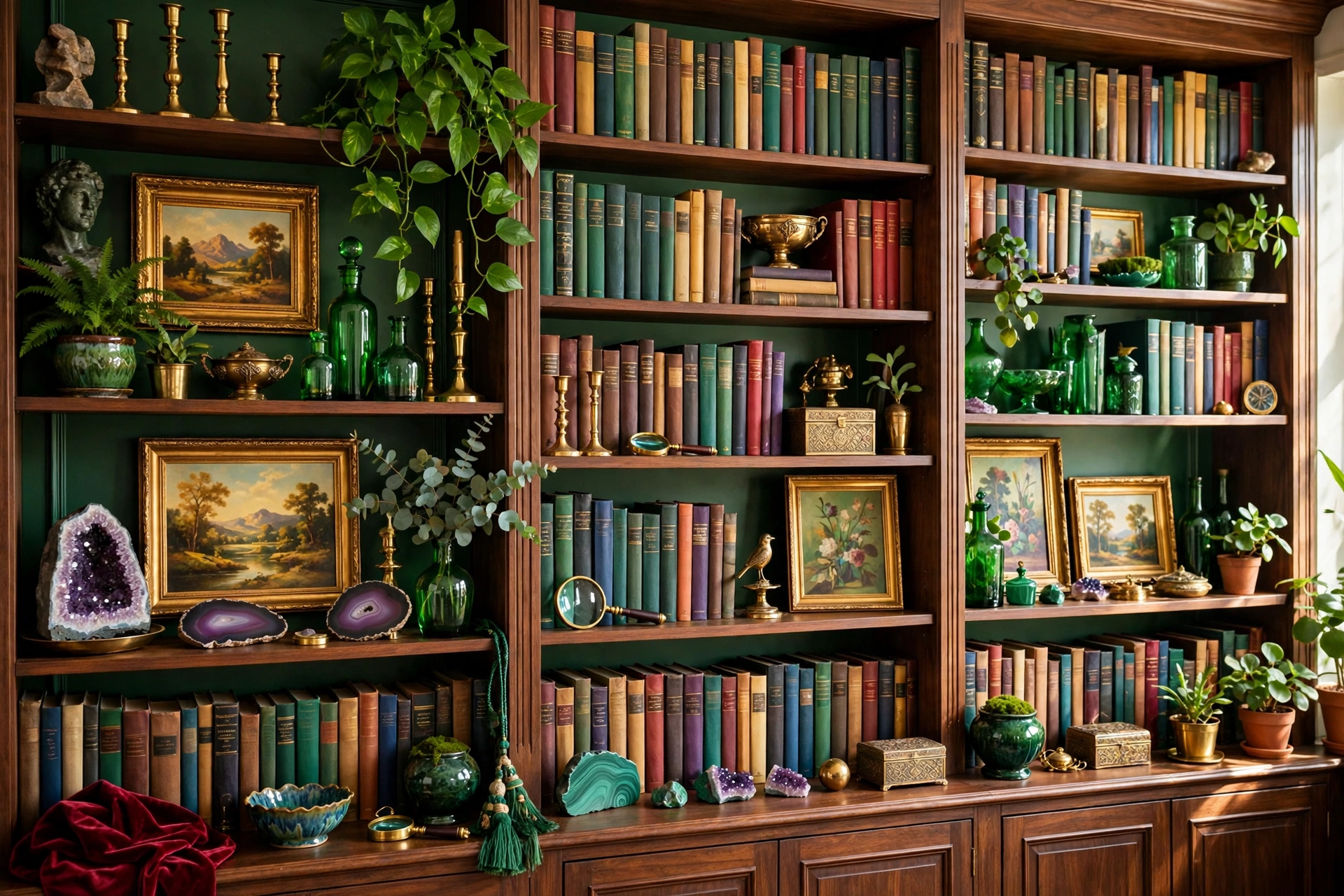
Maximalism is the joyful opposite: shelves layered deep with books, art, objects, plants, and collections until every glance finds something new. Done well, it is not clutter — it is density with structure. The structure comes from a unifying thread: a color palette that repeats, books that still run in organized rows and stacks beneath the layers, and objects grouped in odd-numbered clusters rather than scattered singly.
Work from the back forward: books and large frames at the rear, medium objects in the middle, small treasures at the front edge. Keep a few consistent materials — say, brass, wood, and green glass — appearing on every shelf so the abundance coheres. Maximalist shelves reward the collector and the traveler; every object is a story. Just dust with a feather duster and a system, moving left to right so nothing gets skipped or knocked.
20. Bookcases with Cabinets Below

The bookcase-with-cabinets is the hardest-working furniture formula in the house: closed storage below for the mess, open display above for the beauty. Style the open shelves exactly as you would any bookcase — books, objects, art — but let the closed base take the visual weight, grounding the arrangement. The countertop surface between cabinet and shelves is prime real estate: a lamp, a stack of large art books, or a plant lives well there.
Inside the cabinets, use the space ruthlessly: photo albums, electronics, board games, table linens, the printer — everything a living room needs but no one wants to see. If your bookcase has glass-front cabinets instead of solid doors, treat the interior as display: stack linen-bound books or matching storage boxes inside. Hardware is a cheap upgrade here; swapping plain knobs for brass or leather pulls makes the whole unit read custom.
21. Ladder Shelf Styling

Ladder shelves, with their deep bottom shelves narrowing toward the top, come with a built-in styling map: big and heavy low, small and light high. Anchor the wide bottom shelf with baskets, large books laid flat, or a storage box. Middle shelves carry the classic mix of vertical books and objects. The narrow top shelves take only one or two delicate pieces — a small plant, a candle, a tiny frame — anything more looks precarious.
Because ladder shelves lean against a wall with open sides, keep arrangements centered with clear margins on both sides so nothing appears ready to slide off. They shine in bathrooms (towels and apothecary jars), kitchens (cookbooks and canisters), and entryways. Resist overfilling: the ladder silhouette is the decor, and the shelves look best when the angled frame stays visible through the styling.
22. Corner Bookshelf Ideas

Corners are found space, and a corner bookshelf converts dead square footage into a feature. Whether it is a purpose-built corner unit, two bookcases butted at right angles, or floating shelves wrapping the turn, the styling challenge is the dark inner corner itself. Solve it with light and height: a tall plant, a lamp, or your brightest object belongs in the corner’s depth, pulling the eye in instead of letting it die in shadow.
Carry one element around the bend to unify the two sides — a row of books that continues across the corner, or matching baskets on both lowest shelves. A corner shelf beside a reading chair creates a natural nook; add a small rug and floor cushion and the forgotten corner becomes the most fought-over seat in the house. Keep the top of a corner unit styled too, since it is visible from across the room.
23. Monochrome and Neutral Palettes

A monochrome shelf — all whites and creams, or a moody run of blacks and charcoals — is the most serene styling choice you can make. Achieve it by gathering every book you own in the chosen palette, supplementing with jackets removed or covers wrapped in plain paper if your collection runs short. Objects stay in the same family: white ceramics and clear glass for the pale version, blackened metal and dark wood for the dramatic one.
With color removed, texture becomes the whole game: mix linen, leather, matte ceramic, glossy glass, raw wood, and woven fiber so the eye stays interested. One — exactly one — contrasting accent is allowed and becomes electric: a single green plant on white shelves, or a brass object among black books. Monochrome shelves photograph beautifully and make small, busy collections feel instantly calmer and larger.
24. Painted or Wallpapered Shelf Backing

The back panel of a bookcase is a blank canvas most people ignore. Paint it a deep, saturated color — navy, forest, oxblood, charcoal — and light books and objects will pop against it like exhibits. Or line the back with wallpaper: grasscloth for texture, a small-scale print for charm, a bold botanical for drama. The backing turns an ordinary bookcase, even a budget flat-pack one, into a custom-looking piece.
Removable wallpaper or paint makes this a low-commitment weekend project: empty the shelves, clean, apply, and restyle. Choose a backing that picks up a color already in the room — a cushion, a rug border — so the bookcase ties into the scheme. If the shelves themselves are dark wood, a light backing reverses the effect and brightens the whole unit; either direction beats the default shadowy brown void.
25. Sculptural Statement Objects

Every great shelf has at least one object that is pure shape: an abstract ceramic sculpture, a carved wooden figure, a stone knot, an hourglass, a small bust. Sculptural pieces give the eye a silhouette to admire among all the rectangles of books and frames. Place your statement object where it has room to be seen — alone on a short shelf section, or crowning a horizontal stack — with clear space around it like a plinth in a gallery.
Scale matters more than price: an object should be at least a third the height of the shelf opening or it will read as clutter. One large sculptural piece per bookcase section is the rule; a crowd of small figurines reads as a collection problem rather than a design choice — unless the figurines are a true collection, in which case group them tightly on one shelf and let them be a deliberate exhibit.
26. Oversized Coffee Table Books
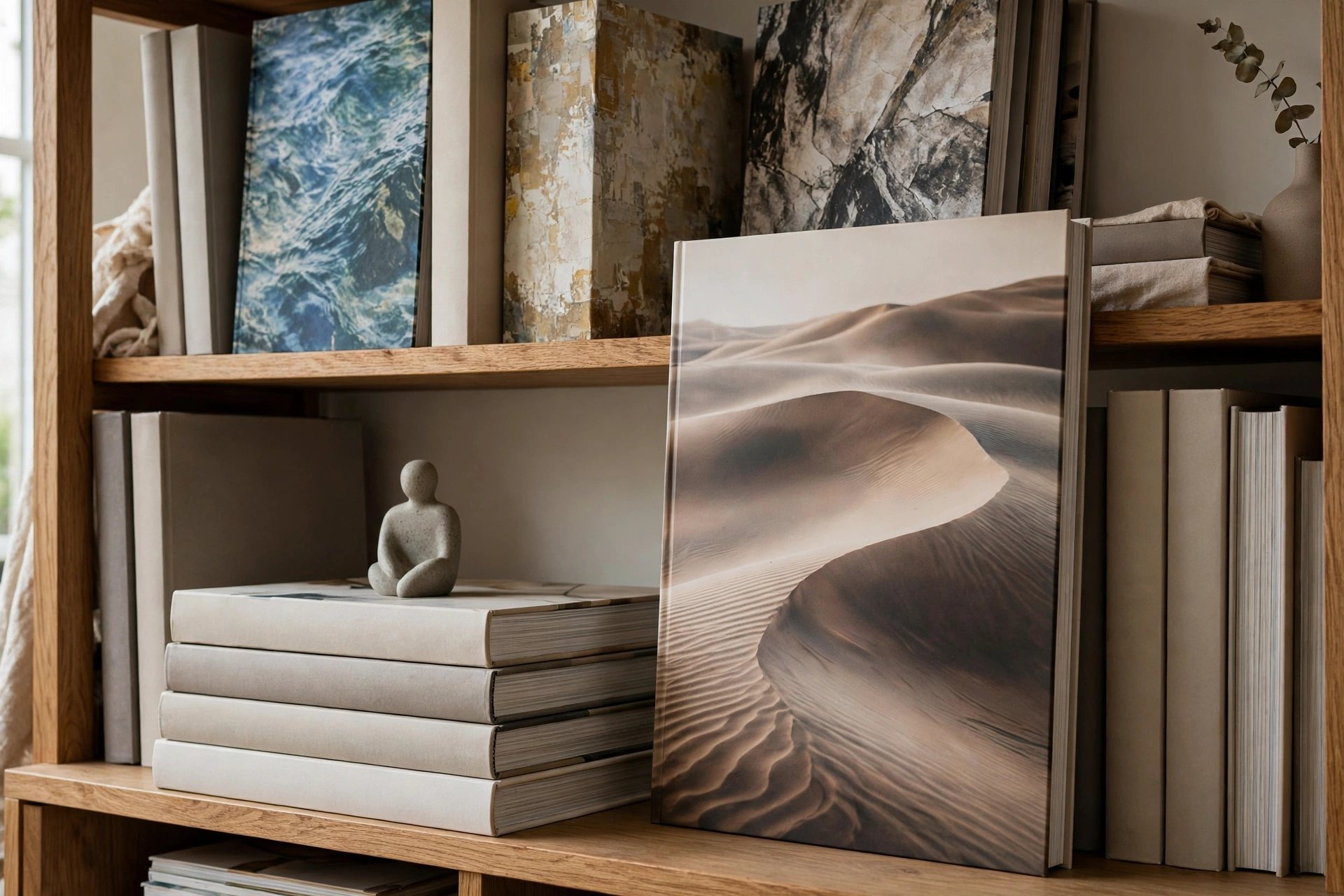
Large-format books — art monographs, travel photography, fashion and architecture volumes — are both reading material and furniture-grade decor. Their size makes them natural anchors: lay two or three flat as the base of a vignette, stand one upright with its cover facing out like artwork, or fill an entire wide shelf with a single row of them. Their covers are designed to be beautiful, so let them show.
Build a coffee table book collection slowly and personally: places you have traveled, artists you love, your own hobbies. They are heavy, so keep the biggest volumes on low shelves or in stacks rather than high vertical rows. A stack of three oversized books topped with a small object is the single most reliable shelf vignette in interior design — when in doubt, build that, then adjust.
27. A Bookshelf Room Divider

An open-backed bookcase pulled away from the wall can divide a studio or open-plan room into zones while letting light pass through — living on one side, work or dining on the other. The styling rule doubles: the shelves are visible from both sides, so arrange books in the center of each shelf depth and place objects that look good from every angle. Baskets and lidded boxes are heroes here, hiding clutter from both viewpoints.
Anchor a freestanding bookcase safely, especially in homes with children, and keep the top shelf light and low-profile so the divider does not feel like a wall about to fall. Push books to alternating sides on different shelves to create a woven rhythm, and let a trailing plant cascade through one opening to soften the grid. A divider shelf styled well makes two small rooms feel bigger than one undifferentiated space.
28. Kids’ Bookshelf Styling
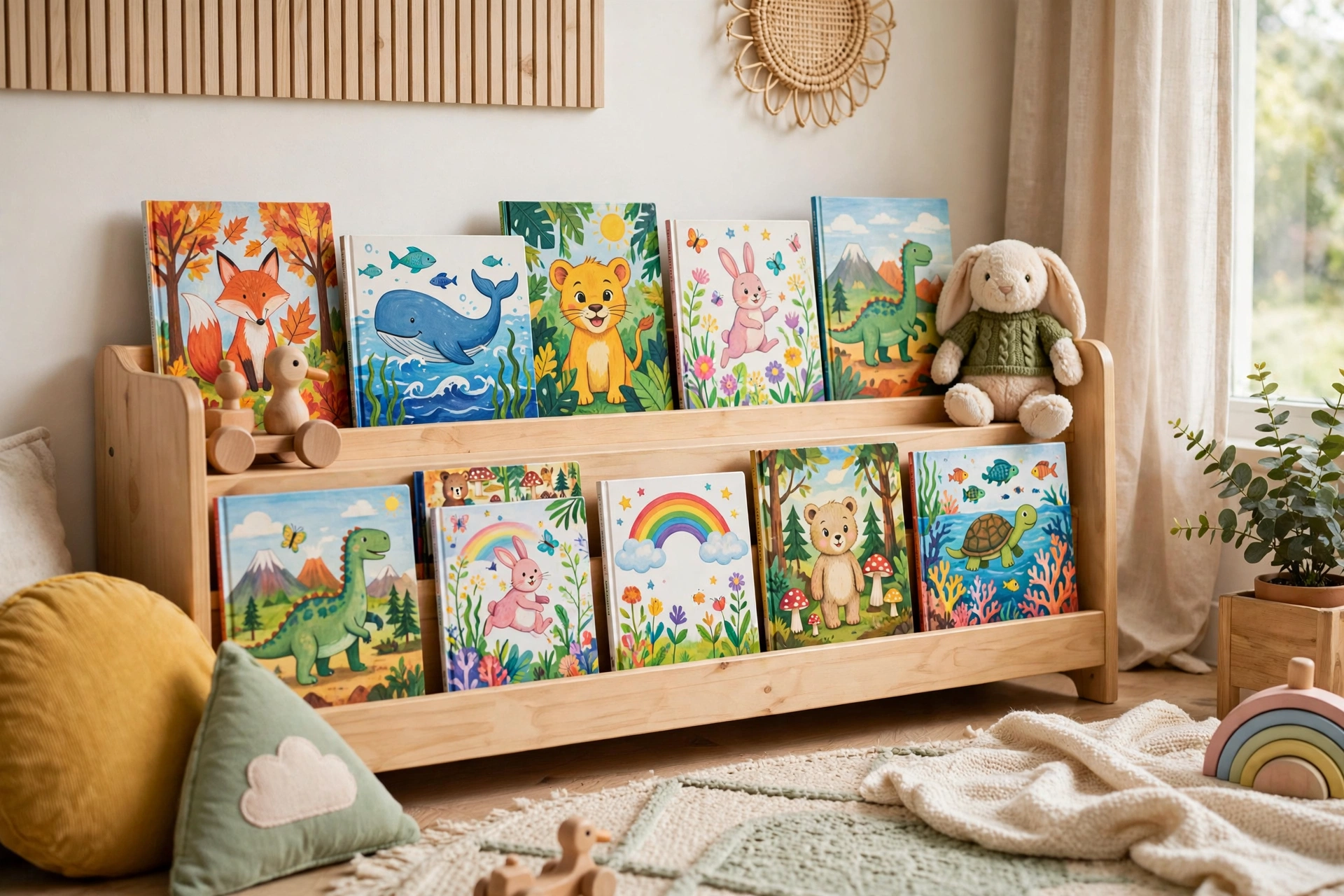
Children’s shelves follow different rules: covers face out, everything sits at small-person height, and durability beats delicacy every time. Forward-facing book bins and low ledges let toddlers choose by picture — and, just as importantly, put books away themselves. Bright primary colors and a rainbow arrangement are not just cute; color sorting is an early organizing skill kids genuinely enjoy maintaining.
Add a few sturdy, touchable objects — a wooden toy, a beloved stuffed animal on duty as bookend, a small basket for treasures — and leave room to grow: collections expand fast. Keep one higher shelf for the parent’s layer: the read-aloud chapter books, a lamp, and the keepsake first editions. A kids’ shelf that looks good and works hard teaches that books live at the center of a home.
29. Home Office and Video-Call Backdrop Shelves

If your bookshelf appears behind you on video calls, it is effectively your professional portrait background, and it deserves a deliberate edit. Aim for tidy rows of books with spines aligned, a plant for life, one or two meaningful objects, and nothing distracting, wobbly, or overly personal in frame. Check the view through your camera, not from your chair — shelves always look different on screen, and glare on glass frames shows up double.
Function still rules the working side: reference books within reach, a box for cables and chargers, files disguised as linen storage boxes. A small lamp on the shelves adds flattering depth behind you on calls, separating you from the background. Keep the styling a notch more conservative than your living room shelves — calm, organized, credible — and restyle seasonally only outside the camera’s crop.
30. Candles and Ambient Accents

Candles bring warmth, scent, and — when lit — the flicker that makes a whole bookcase feel alive at night. Cluster pillar candles on a small tray, stand tapers in brass holders at the end of a row, or use a single beautiful jar candle as the object atop a stack. Keep real flames sensible: stable holders, clearance from book spines and trailing plants, and never leave them burning unattended.
Flameless LED candles with timers are the set-and-forget alternative, and on a shelf — especially a high one — even designers cannot tell the difference at a glance. Scent is the bonus layer: a cedar or tobacco candle near leather-bound books, something green and herbal beside plants. Group candles in odd numbers and vary the heights, and let one shelf carry the candle moment rather than scattering singles everywhere.
31. Asymmetrical Balance
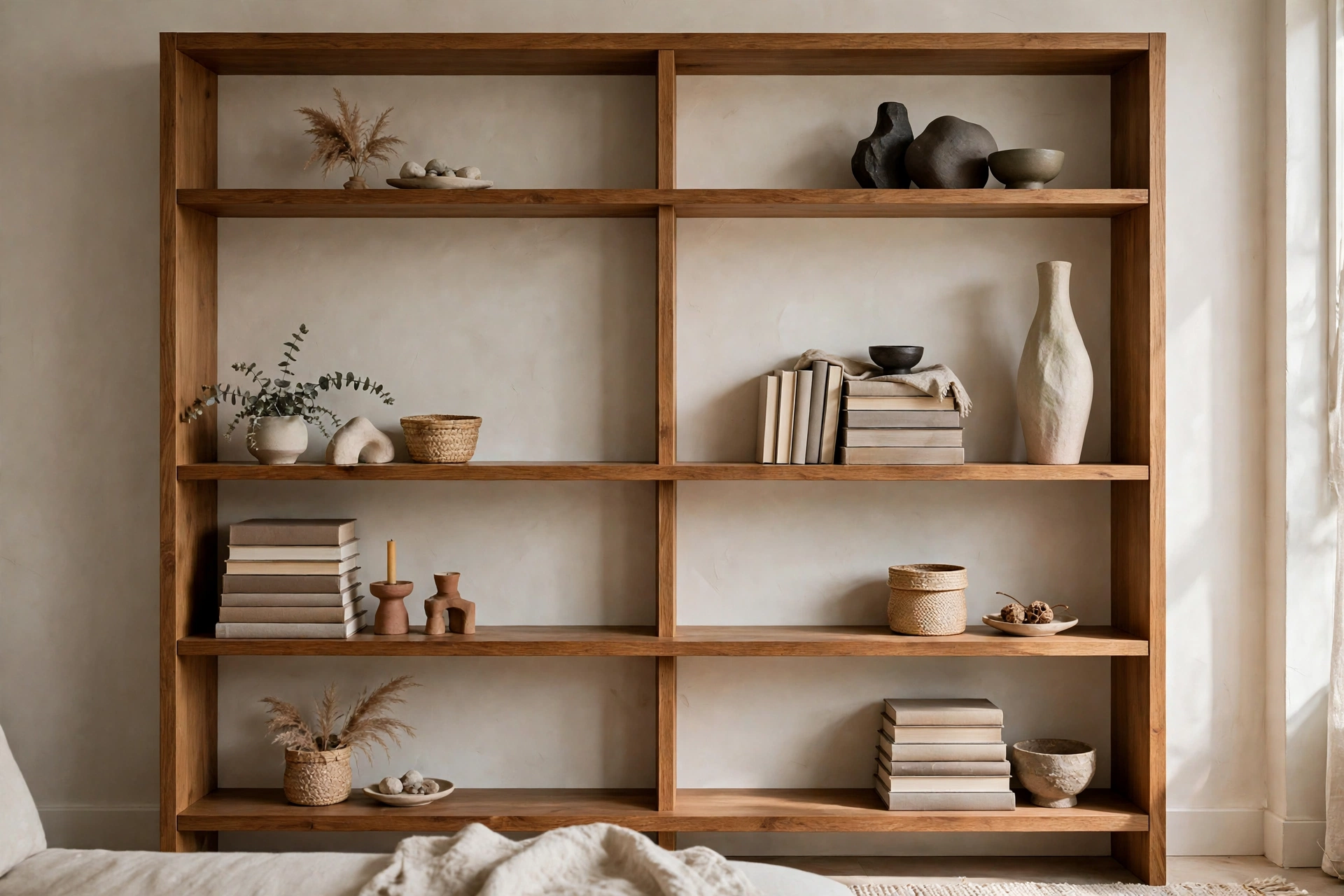
Perfect symmetry on shelves looks staged; asymmetrical balance looks designed. The technique: instead of mirroring arrangements on the left and right of a shelf, balance visual weight — a tall stack of books on the left answered by a single tall vase on the right, a dense cluster on one shelf answered by a light, airy arrangement on the shelf below the opposite side. The bookcase balances as a whole, not shelf by shelf.
Work diagonally: place your heaviest-looking groups in a zigzag down the bookcase so the eye travels. If one side of the unit is all books and the other all objects, it will feel lopsided no matter how pretty each side is — interleave them. Step back and take a phone photo; the camera flattens your arrangement into pure shape and color, and imbalance you could not feel in person becomes obvious on screen.
32. Decorative Storage Boxes

Lidded boxes are the polished cousin of the storage basket: they hide the same clutter but read as decor. Linen, leather, lacquered wood, and patterned paper boxes stack neatly, fill awkward short shelves, and give collections of small things — letters, photos, sewing kits, game pieces — a dignified home. A pair of matching boxes can also serve as a bookend or as the base that lifts a small object to its proper height.
Keep boxes in the shelf’s palette and mix sizes deliberately: one large box low, two smaller ones stacked higher. Label the contents discreetly on the side facing the wall if you are the forgetful type. Beware the box graveyard — if a box has not been opened in a year, its contents probably belong elsewhere. Used honestly, boxes are how real households keep styled shelves without giving up storage.
33. Globes, Maps and Travel Mementos
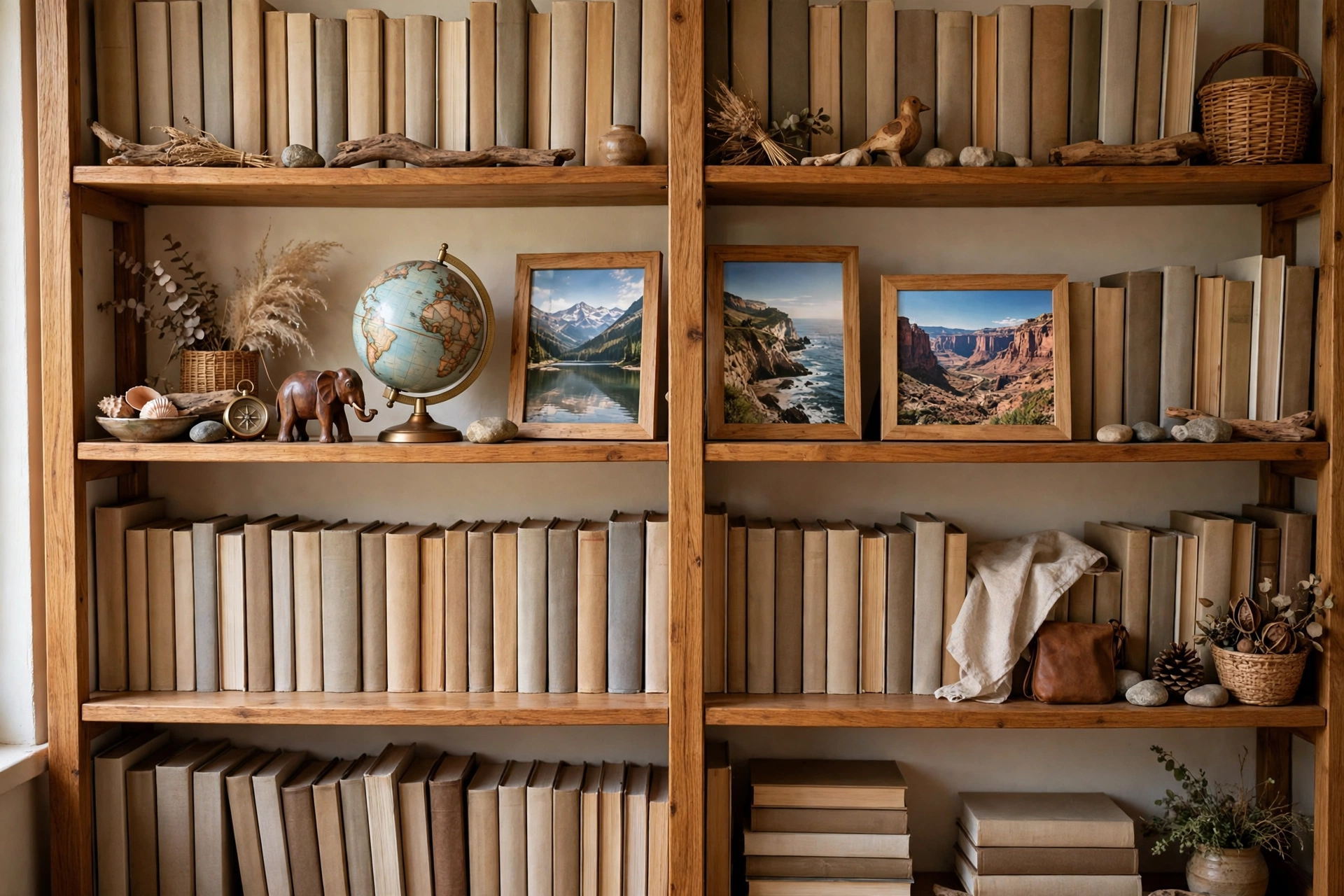
Travel pieces give shelves a story no store can sell you. A small vintage globe is a classic shelf anchor — spherical, colorful, and interesting from across the room — while framed map fragments, postcards, and souvenirs from trips layer in the personal. The styling secret is editing: choose the best few pieces and give them room, rather than lining up every trinket from every trip until the shelf becomes a souvenir shop.
Group travel objects near the books they belong with: the Italy shelf with the guidebooks, the ceramic tile from Lisbon, and the photo from the trip. A globe on top of the bookcase, slightly oversized for the space, makes a wonderful crown. Maps work as backing art behind a shelf section, too — frame a large one or pin it inside the back panel for an instant themed backdrop.
34. Vary Height, Depth and Layering

Flat is the enemy. Shelves styled in a single line — every book the same height, every object at the front edge — look like a store stockroom. Instead, deliberately vary all three dimensions: heights (a tall vase beside short stacks), depths (frames leaned at the back, small objects pulled to the front edge), and layers (a plant partially in front of books, art overlapping spines). This dimensional play is most of what “styled” actually means.
A practical method: for each shelf, choose one tall item, one medium item, and one low item, and place them in a loose triangle. Push some book rows flush to the back and pull others forward so the front line undulates slightly. Risers are your friends — a small box or stack of books under an object instantly changes its height class. Keep the very front edge mostly clear so layers read as depth, not as items about to fall.
35. Open Kitchen Shelves for Cookbooks
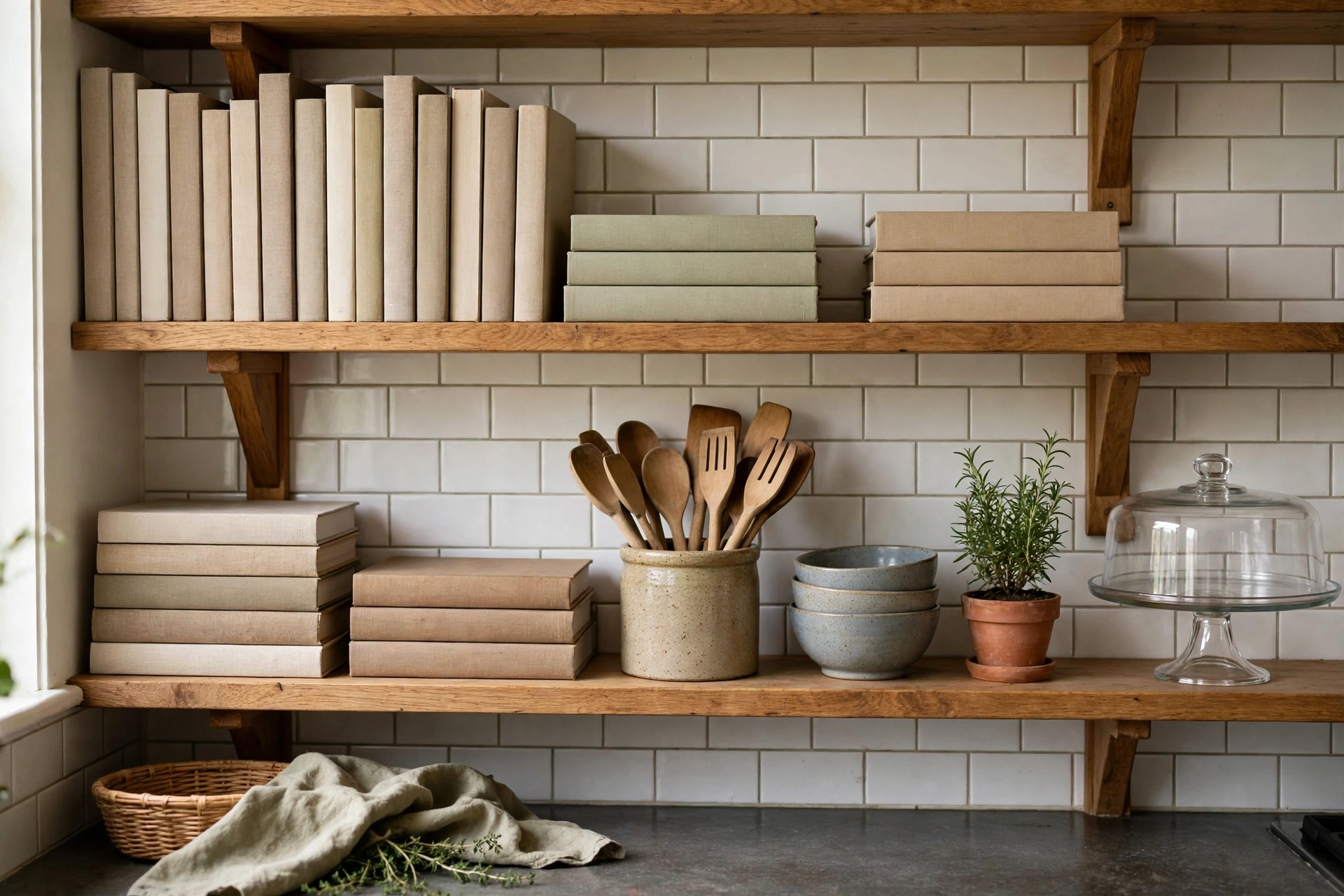
Cookbooks are the hardest-working decorative books in the house: beautiful covers, daily use, and a natural home on open kitchen shelves. Style them like any bookcase — vertical runs broken by horizontal stacks — but mix in the tools of the trade: a crock of wooden spoons, a small potted herb, stacked bowls, a cake stand. The combination of books and kitchenware reads as a working library, which is exactly the charm.
Keep the most-used cookbooks at counter height and the big aspirational volumes higher; a small stack by the stove with the current favorite propped open on a stand is both practical and inviting. Kitchen shelves collect grease and dust faster than any others, so favor wipeable objects and washable book jackets, and embrace the slightly patinaed look of books that are genuinely cooked from.
36. Breathing Room: The Power of Negative Space

The most counterintuitive idea on this list is the last: leave some shelf space completely empty. Negative space is not the absence of styling — it is the styling. An empty stretch beside a beautiful arrangement doubles its impact, gives the eye rest stops as it travels the bookcase, and signals the confidence of a room that does not need to show everything it owns. Designers call it breathing room, and its absence is why most home shelves feel busy.
Practical ways to build it in: leave the end third of one shelf bare, keep one whole shelf at half capacity, or frame a single object with emptiness on both sides like a sculpture in a gallery. When you add a new book or object, let the rule be one-in-one-out so the breathing room survives. If your shelves ever feel almost right but somehow exhausting, do not add a thing — take two things away and watch the whole arrangement relax.
More Home Decor Ideas
- Wall Decor Ideas: 36 Stylish Designs for Every Room
- Gallery Wall Ideas: 36 Layouts and Designs
- Front Porch Decor Ideas: 36 Welcoming Designs
- Coffee Table Decor Ideas: 36 Stylish Arrangements
- Laundry Room Decor Ideas: 36 Fresh Designs
- Mudroom Decor Ideas: 36 Organized Entry Designs
- Home Coffee Bar Ideas: 36 Cozy Station Designs
Final Thoughts
Beautiful bookshelves are not bought; they are composed — a few books moved, an object given room, a plant added, a light switched on. Start with the formulas that spoke to you: balance books with objects and empty space, vary heights and directions, repeat a material or color until it becomes a rhythm, and always leave a little breathing room. Then live with your shelves, adjust them with the seasons, and let them keep telling your story. The best-styled shelf is never finished — it just keeps getting more yours.