
Organization Hacks: 36 Clever Ideas for Every Room
A tidy home is not about having less — it is about giving everything you own a clear, easy-to-reach…

A tidy home is not about having less — it is about giving everything you own a clear, easy-to-reach home. The best organization hacks work because they fit the way you actually live: they cut the friction out of daily routines, make the most of forgotten corners, and turn chaotic catch-all zones into systems that practically run themselves. You do not need a renovation or a big budget to feel the difference.
This guide collects 36 clever, room-by-room organization hacks that real homes swear by. From double-hang closet rods and pantry zones to cable management and whole-home command centers, each idea includes practical detail so you can put it to work this weekend. Pick the three that would change your mornings the most, and start there.
1. Double-Hang Your Closet Rods
Most closets waste the lower half of their hanging space on air. Installing a second rod below the first instantly doubles your hanging capacity: keep shirts, blouses, and jackets on the upper rod and pants, skirts, and folded-over jeans on the lower one. A tension rod or an inexpensive hanging rod extender works in rentals without drilling a single hole.
Group each rod by category and then by color so getting dressed feels like browsing a boutique instead of digging through a pile. Matching slim hangers keep everything uniform and save inches on both rods, which adds up to real space across a full closet.

2. Divide Dresser Drawers With Inserts
Deep dresser drawers become black holes where socks and tees disappear. Bamboo or plastic drawer dividers carve one big drawer into tidy compartments, so every category — underwear, socks, tees, workout gear — has its own lane. Adjustable spring-loaded dividers fit any drawer width with zero tools.
Pair dividers with file-folding (idea 15) and you will see every item at a glance instead of only the top layer. Assign the front compartments to daily essentials and the back ones to less-used items, and the drawer practically organizes itself as you put laundry away.

3. Set Up Kitchen Work Zones
Professional kitchens run on zones, and your kitchen should too. Create a prep zone (cutting boards, knives, mixing bowls near the counter), a cooking zone (pots, pans, utensils, oils by the stove), and a serving zone (plates, glasses near the dishwasher or dining area). Store each tool where its task happens and you will stop crisscrossing the kitchen mid-recipe.
Zones also make cleanup faster because every item has an obvious home within arm’s reach of where it gets dirty. Label the inside of cabinet doors with the zone name for the first month — once the habit sticks, the system runs on autopilot.

4. Corral the Pantry With Bins and Labels
A pantry without containers is just a shelf of half-open bags. Clear bins grouped by category — snacks, baking, breakfast, canned goods — turn a jumbled pantry into a mini grocery store where everything is visible. Decant staples like flour, rice, and cereal into airtight canisters so they stay fresh and stack neatly.
Labels are the glue that holds the system together, especially with kids or roommates. A label maker or simple chalkboard tags tell everyone exactly where things belong, which means the pantry stays organized long after the initial tidy-up.

5. Roll Storage Under the Bed
The space under your bed is prime real estate hiding in plain sight. Low rolling bins or zippered under-bed bags swallow off-season clothes, extra bedding, shoes, and gift wrap without stealing an inch of closet space. Choose bins with lids to keep dust out and wheels or handles so they glide out easily.
Divide the under-bed zone by side — your things on one side, your partner’s on the other — or by category with one bin per season. A quick vacuum under the bed twice a year keeps this hidden storage fresh and functional.

6. Build an Entryway Drop Station
Clutter is born at the front door, so stop it there with a dedicated drop station. A bench with shoe storage underneath, wall hooks for bags and jackets, and a small tray or bowl for keys, sunglasses, and mail gives every arrival item an instant home. Even a narrow console table with a basket beneath works in tight foyers.
The secret is making the station easier to use than the nearest flat surface. Keep it to one hook and one basket slot per person so the system cannot overflow, and empty the mail tray into your sorting station weekly.

7. Tame Bathroom Drawers With Organizers
Bathroom drawers devolve into a tangle of half-used products fast. Acrylic or bamboo drawer organizers with compartments for skincare, dental care, hair tools, and daily medications turn the chaos into a tidy grid where everything is findable. Stackable trays double the usable space in deep drawers.
Do a ruthless product audit first: toss expired sunscreen, dried-out mascara, and the samples you will never use. With only keepers left, assign each compartment a category and corral backups in a separate bin so the drawer never overflows again.

8. Hide Cables in a Management Box
The tangle of chargers and power strips behind your desk or TV stand is visual noise you can eliminate in ten minutes. A cable management box hides the power strip and excess cord length inside a ventilated container, leaving only the cords you actually need visible. Adhesive cord clips route the remaining cables neatly along furniture edges.
Label both ends of every cord with small tags before you box them up — future you will be grateful when it is time to unplug one device. Velcro ties beat zip ties because you can reopen them whenever your setup changes.

9. Go Vertical With a Pegboard
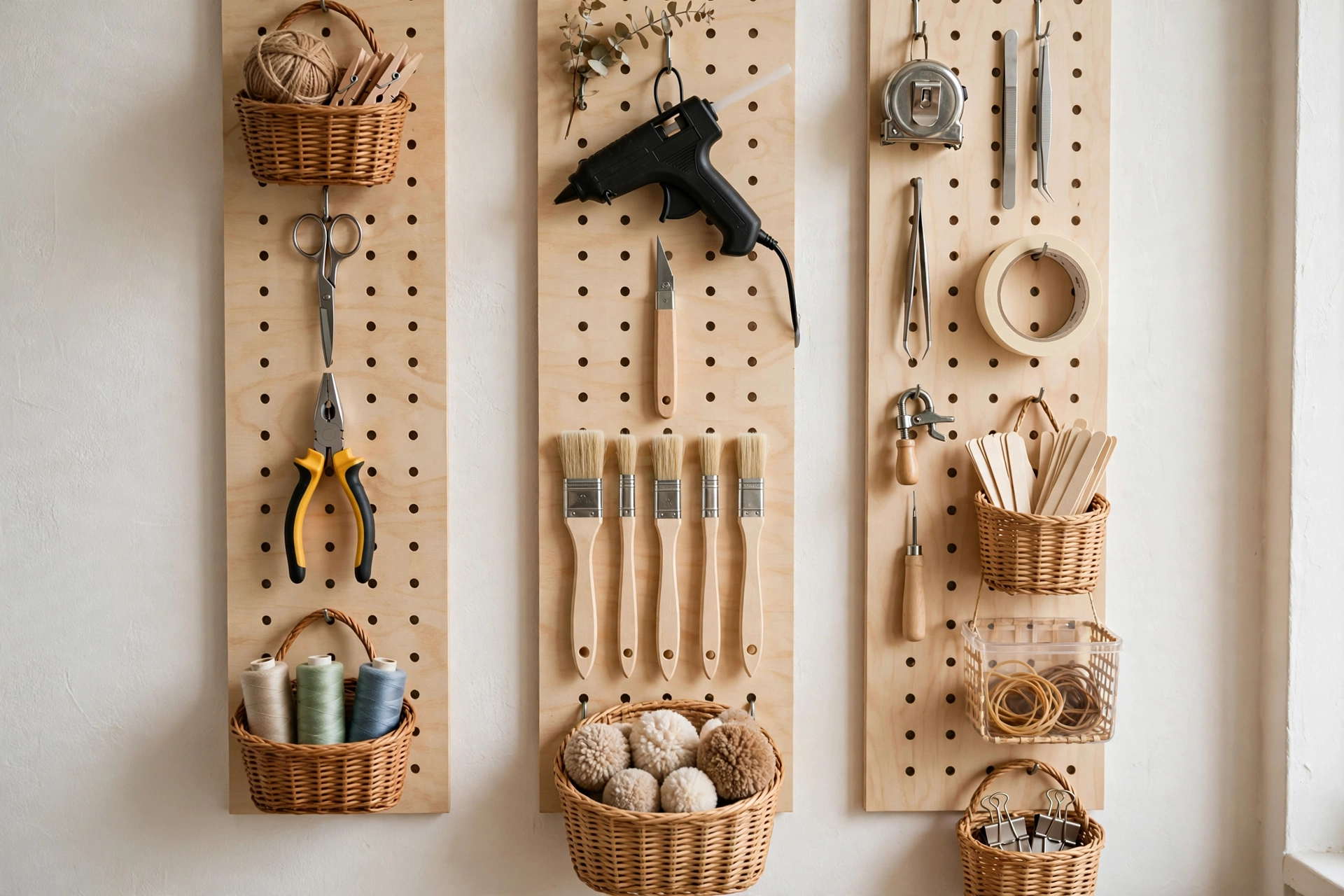
When floor and drawer space run out, the wall is your next frontier. A pegboard with hooks, baskets, and small shelves turns a blank wall into endlessly reconfigurable storage for craft supplies, tools, kitchen gadgets, or office gear. Everything stays visible and reachable, which is half the battle with organization.
Outline each tool’s spot with a marker or paint pen so missing items are obvious at a glance. In kitchens, a small pegboard inside a pantry door keeps measuring cups and oven mitts handy without touching the counter.
10. Practice the One-In-One-Out Rule
Organization systems collapse when new things keep arriving with no exit plan. The one-in-one-out rule is beautifully simple: every time something new enters your home, something old leaves — donate it, sell it, or recycle it. Keep a permanent donation box in a closet so the “out” part happens immediately instead of someday.
This habit is the single best defense against re-cluttering because it caps your total possessions automatically. Apply it first to the categories that grow fastest in your home — clothes, kids’ toys, and kitchen gadgets — and watch your storage stop overflowing.

11. Mount Spice Racks Inside Cabinet Doors
The inside of a cabinet door is wasted space in most kitchens. Slim mounted spice racks turn that dead surface into tiered storage for spice jars, freeing an entire shelf inside the cabinet for bigger items. Most racks install with adhesive strips or two small screws and hold jars securely.
Alphabetize the jars once and cooking becomes dramatically faster — no more hunting for the cumin behind the paprika. This same trick works on pantry doors for packets and on bathroom cabinet doors for small toiletries.

12. Bin Up the Linen Closet
Linen closets turn into avalanche zones because loose stacks of sheets and towels have no structure. Fabric or plastic bins — one per category: fitted sheets, flat sheets, pillowcases, bath towels, hand towels — give every stack rigid walls. Folded items stay put instead of toppling when you pull one out.
Store complete sheet sets inside one of their own pillowcases so the whole set comes out as a bundle — no more hunting for the matching fitted sheet. Label each bin on the front edge so guests and family can find (and return) things without your help.

13. Hang an Over-Door Hook Rack
Doors are vertical storage waiting to happen. An over-door hook rack adds five or six hanging spots for robes, tomorrow’s outfit, bags, hats, and belts with zero installation — it just hooks over the top of any standard door. Use it in bedrooms, bathrooms, and kids’ rooms where floor space is precious.
The trick to keeping it tidy is the one-hook-one-category rule: robe on one hook, bag on another, never a pile. Felt pads on the back prevent rattling and protect the door’s finish.

14. Squeeze In a Rolling Utility Cart
Every home has a dead gap — between the washer and the wall, beside the vanity, next to the fridge — that is exactly cart-width. A slim three-tier rolling cart slides into those six-inch gaps and holds cleaning supplies, toiletries, or pantry overflow, then rolls out when you need access.
Measure your gap before buying, and choose a cart with locking wheels so it stays put. In bathrooms, the top tier becomes a perfect home for daily products while lower tiers hold backups and refills.

15. File-Fold Your Clothes
Stacking folded clothes hides everything below the top item; file-folding stands each piece upright like files in a drawer so you can see and grab any item without disturbing the rest. Fold each garment into a neat rectangle, then fold once more so it stands on its own edge.
This method roughly doubles usable drawer space because clothes pack tighter with no dead air between stacks. It works for tees, jeans, leggings, and even underwear — and drawers stay neat because nothing gets buried.

16. Rotate Toys Instead of Storing Them All
Kids play with a fraction of their toys while the rest create chaos. A toy rotation system keeps only one curated bin of toys out at a time and stores the rest in labeled bins in a closet. Every week or two, swap the bins — the “new” toys feel exciting again and cleanup takes minutes.
Sort bins by type — building, pretend play, art, puzzles — so each rotation offers variety. Fewer toys out also means kids play more deeply with what they have instead of skimming across a mountain of options.

17. Give Everyone a Mudroom Cubby
Shared entryways descend into chaos when four people’s gear competes for one hook. Individual cubbies — one per family member, each with its own hooks, shoe shelf, and basket — end the turf war. Even a simple bookcase with labeled baskets per person creates the same effect in a hallway.
Size each cubby to real life: two hooks minimum per person (coat + bag), a shoe shelf that fits daily pairs, and a basket for gloves, hats, and sunscreen. When guests visit, designate one cubby as the guest zone so their things do not colonize everyone else’s.

18. Line Jewelry Drawers With Trays
Tangled necklaces and single earrings are the price of tossing jewelry into one drawer. Velvet or velvet-lined trays with divided compartments keep every piece separate and visible — necklaces laid flat in long slots, rings in rolls, earrings paired in small squares. Stackable trays fit inside a standard dresser or nightstand drawer.
The visibility bonus is real: you will actually wear the pieces you can see. Hang statement necklaces on small hooks inside a closet door if drawer space is tight, and keep a tiny dish on the dresser for the pieces you wear daily.

19. Corral Daily Essentials in a Catch-All Tray
Keys, wallet, sunglasses, and loose change scatter across every flat surface unless they have a designated landing pad. A single handsome tray on the entry console or kitchen counter becomes the official home for pocket contents — containment with style. The tray’s edges are the magic: they visually signal that this is the boundary, not the whole counter.
Empty the tray of anything that is not a daily essential once a week; receipts and random screws migrate to their real homes. One tray per adult keeps the system from becoming a communal junk pile.

20. Sort Mail the Second It Arrives
Paper clutter multiplies because mail has no workflow. A wall-mounted sorter or desktop file with three slots — action, file, recycle — forces a decision the moment mail enters the house. Bills and invitations go in action, statements in file, junk straight to recycle without ever touching the counter.
Process the action slot twice a week: pay, RSVP, or file, then it is empty again. Going paperless for statements and bills shrinks the whole system further — the best mail to organize is the mail that never arrives.

21. Spin Deep Shelves With Lazy Susans
Deep pantry and cabinet shelves hide items in the dark back corners where they expire forgotten. A lazy Susan turntable brings the back of the shelf to you with one spin — perfect for oils, vinegars, condiments, vitamins, and spice collections. Two-tier versions double the capacity in tall cabinets.
Group like items on each turntable so one spin serves one task: a cooking turntable with oils and sauces, a baking one with extracts and powders. Non-slip liners keep jars from sliding, and a quick wipe keeps the mechanism spinning freely.

22. Add Hanging Shelves to Closets
Long hanging rods waste the airspace beside your clothes. Hanging fabric or canvas shelves hook right over the rod and create instant cubbies for folded jeans, sweaters, handbags, and shoes — no drilling, no tools, and they move with you when you relocate.
Use the top cubbies for off-season or rarely worn items and the middle ones for daily favorites at eye level. Sturdier hanging shelves with side supports hold heavier items like boots and bags without sagging.

23. Hang Spray Bottles on a Tension Rod
The cabinet under the sink is prime storage ruined by plumbing and a jumble of bottles. A spring tension rod mounted across the cabinet turns dead air into a hanging rack for spray bottles — their triggers hook right over the rod, lifting them off the floor and freeing the base for bins of sponges and refills.
Measure the cabinet width before buying so the rod fits snugly. Add a small lazy Susan or pull-out bin underneath for the remaining supplies, and line the cabinet floor with a waterproof mat to catch drips.

24. Store Shoes Vertically
Shoes lined up on the closet floor eat linear feet fast. A tall vertical shoe rack — tower, over-door, or stackable cubbies — stores the same pairs in a fraction of the footprint by going up instead of out. Clear or open-front designs let you spot the pair you want instantly.
Keep only in-season, regularly worn shoes in the prime rack; store off-season and occasion pairs in labeled boxes on a high shelf. A one-pair-in, one-pair-out habit keeps the collection from outgrowing the rack.

25. Sort Laundry at the Source
Sorting a mountain of mixed laundry is a chore nobody enjoys — so stop creating the mountain. A triple-sorter hamper with sections for lights, darks, and delicates sorts every load automatically as clothes go in. When a section fills up, that is a ready-to-wash load with zero sorting required.
Place a small mesh bag in the delicates section for items that need it, and they go straight into the washer protected. Rolling hampers with removable bags make transporting sorted loads to the laundry room effortless.

26. Zone Your Desk Drawers
Desk drawers become junk drawers when everything shares one space. Shallow organizers divide the drawer into zones — writing tools, paper goods, tech accessories, and a small “action” tray for things needing attention. The shallow depth keeps every zone visible at a glance.
Reserve one zone as the deliberate junk zone if you must, but cap it at a single small tray — containment keeps it from spreading. A weekly two-minute reset, tossing dried pens and stray receipts, keeps the zones working.

27. Mount a Garage Wall Track System
Garage floors disappear under bikes, tools, and sports gear. A slat-wall or track system with hooks, baskets, and brackets moves everything onto the walls — bikes hang by their frames, tools slot into holders, and bins stack in cradles. The floor stays clear for cars and projects.
The beauty of tracks is reconfigurability: hooks slide and swap as your gear changes with the seasons. Mount tracks into studs for heavy items, and keep a step stool nearby so high hooks actually get used instead of avoided.

28. Bin the Fridge With Clear Containers
Fridges hide leftovers until they become science experiments. Clear bins — one for produce, one for dairy, one for condiments, one for leftovers — group everything into visible zones so nothing gets lost behind the milk. Because the bins are transparent, you can see stock levels without unpacking anything.
Give leftovers a dedicated “eat me first” bin at eye level so they actually get eaten. A weekly five-minute fridge audit before grocery shopping cuts waste and stops duplicate buying.

29. Box Seasonal Items for Rotation
Holiday decor, winter coats, and summer gear do not deserve prime storage year-round. Clear stackable boxes — one per season or holiday — live on high shelves or in the garage, and only the current season’s box comes down. Clear walls mean you can identify contents without opening anything.
When you pack a season away, purge as you go: broken ornaments and stretched-out sweaters do not earn a box. A simple inventory list taped inside each lid saves you from buying duplicates next year.

30. Hang a Bedside Caddy
Nightstands overflow with books, chargers, glasses, and remotes competing for a tiny surface. A fabric caddy that hangs over the mattress edge or bed frame adds deep pockets for all of it — book, phone, glasses, remote — keeping the nightstand surface clear for just a lamp and water.
Choose a caddy with a rigid pocket for the phone so it charges without sliding out. In kids’ rooms, the same caddy corrals bedtime books and stuffed animals that would otherwise migrate across the floor.

31. Tier Cans With Risers
Canned goods lined up single-file hide everything behind the front row. Tiered can risers — stair-step shelves for the pantry — lift back rows into view so you can see your entire stock at a glance. No more buying a fourth can of tomatoes because you could not see the three behind it.
Sort cans by type on each tier and face labels forward for a grocery-store look. Adjustable risers fit different can heights, from tuna tins to tall soup cans.

32. Rack Lids on Cabinet Doors
Pot lids are the awkward puzzle pieces of kitchen storage — they never stack with their pots. A rack mounted inside a cabinet door holds lids upright in slots, matched with their pots nearby. Suddenly the cabinet that held a clattering lid pile gains real usable space.
Adhesive-mount racks work for lighter lids in rentals; screw-mounted ones handle heavy cast iron. If you would rather keep doors clear, a vertical lid organizer inside the cabinet achieves the same upright storage.

33. Wrap and Tag Every Cord
Unlabeled cords are a mystery box: unplug the wrong one and the Wi-Fi dies. Velcro cord wraps bundle each cable neatly, and small tags at both ends name the device — “TV power,” “router,” “lamp.” The next time you need to unplug one thing, you will know exactly which cord it is.
Coil excess length instead of letting it dangle; a wrapped coil behind the furniture disappears. Color-coded wraps take it further: one color per person or per zone for instant identification.

34. Add Risers to the Medicine Cabinet
Medicine cabinet shelves are shallow, so bottles hide behind bottles. Small acrylic risers create a second tier inside the cabinet, lifting back-row items into view above the front row — like stadium seating for your vitamins and prescriptions. Everything becomes reachable without knocking things over.
Check expiration dates when you install the risers and toss anything outdated — most homes find at least a few. Group by person or by purpose (daily, as-needed, first aid) so the right bottle is always the easy one to grab.

35. Roll Towels Spa-Style
Rolled towels look luxurious, save shelf space, and — best of all — you can pull one from the stack without toppling the rest. Roll each towel tightly from one short end, tuck the loose edge, and line the rolls up in rows on the shelf or in a basket. The uniform cylinders pack tighter than folded stacks.
This works for bath towels, hand towels, and washcloths alike, and it transforms open shelving into a display-worthy feature. Keep one basket of daily towels at arm’s reach and the rest rolled in the linen closet.

36. Run the House From a Command Center
A family command center is mission control for the whole household: one wall with a shared calendar, key hooks, mail slots, a whiteboard for notes, and a charging station. When everyone checks the same wall, permission slips get signed, appointments get remembered, and keys stop vanishing.
Keep it ruthlessly current — an outdated calendar is worse than none because people stop trusting it. A Sunday five-minute reset with the whole family updates the week ahead and keeps the system alive.

Final Thoughts
The best organization hack is the one you will actually maintain, so start small: pick the two or three ideas from this list that would make your busiest mornings smoother, and implement just those this weekend. Once a system proves itself, it is easy to expand — and a home where everything has a place is a home that stays tidy with far less effort than you expect.